







Website Search
Learning doesn’t stop at the end of the school day. The Lexington Public Library is here to support your education at every level, from birth through college, with skill-building tools, live tutoring, standardized test prep, after-school programs, and more.
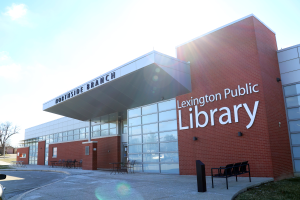
Lexington, Kentucky (March 9, 2022) – Lexington Public Library and Lexington Public Library Foundation are honored to announce that the Marksbury Family Foundation has committed the lead gift for the capital campaign to rebuild the library branch at the corner of Versailles Road and Village Drive. In recognition of their generosity, the new facility will be named the Marksbury Family Branch when it opens in 2024.
Celebrate National Poetry Month at LPL
The Lexington Public Library is celebrating National Poetry Month throughout April! Find reading recommendations, explore Lexington’s rich literary history, and discover fun ways to get involved.
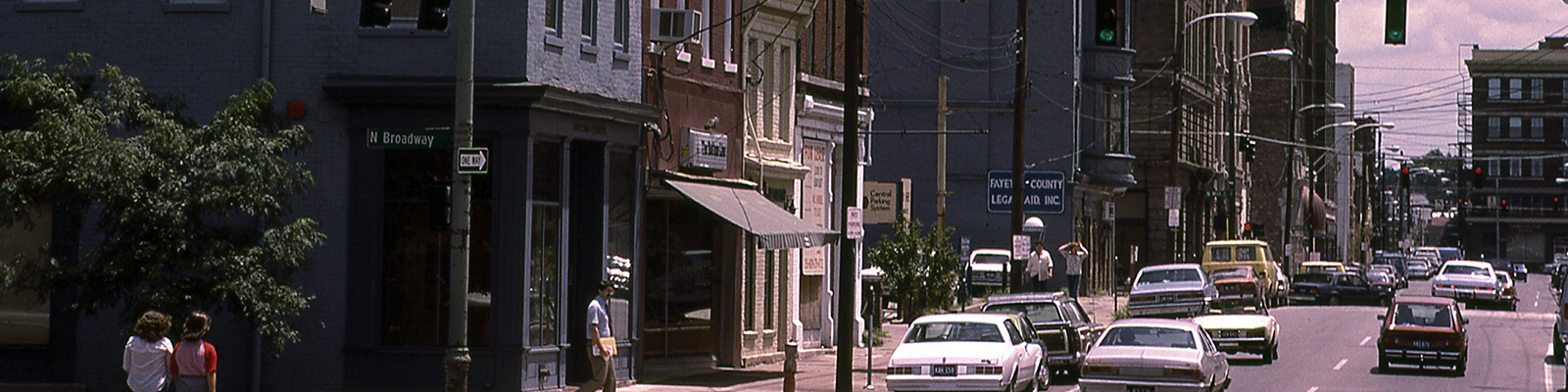
Lexington History Museum Collection
The Lexington History Museum began in 1998, and opened its doors in the Old Courthouse in 2003. Its purpose is to educate Fayette County about its rich history, and preserve pieces of that history for future generations. The Old Courthouse closed in 2012 for extensive renovations. The History Museum still creates exhibits and works on school and film collaborations to create an understanding and appreciation of local history.
The History Museum's Community Collections currently contains part of the exhibit "Our Fair City: The 1999 Lexington Fairness Ordinance," which was displayed in the summer of 2019 at the Lexington Public Library, to celebrate the 20th anniversary of the ordinance's passage.
All Digital Archives Collections
The first Kentucky almanacs were printed by John Bradford, on the same printing press that published the Kentucky Gazette. The Kentucky almanacs in the library's…
Fayette County's buildings contain a great deal of history about the region and its inhabitants. The earliest structure in Lexington was built in 1779, the Blockhouse. Lexington currently has over…
The collection consists of an image, homemade brochures, flyers, pamphlets, and programs covering LGBTQ+ events and places from 1983 to 1999 in both Lexington and Louisville. Subjects include…
The Bath County Memorial Library was founded in 1949 by the Owingsville Women’s Club, and opened in January, 1950. It expanded into a bookmobile in 1953, and in 1963 moved into the old Farmer’s…
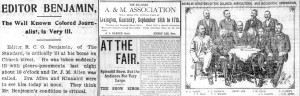
The Black Community News Collection compiles searchable newspaper articles and ads for local Black community events, schools, social gatherings, church events, obituaries, and wedding…
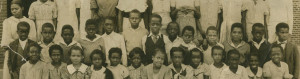
The Brown-Hocker Collection is a community collection of photos and realia from African American events and people in Lexington and Kentucky history.
The objects in the collection are…
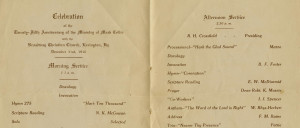
This collection contains materials from Lexington and Fayette County religious groups.
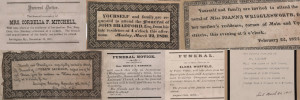
Compiled by Cyrus Parker Jones, a man formerly enslaved by the Parker family, these funeral notices cover 667 funerals of individuals in Lexington, including seven free blacks. The funeral notices…
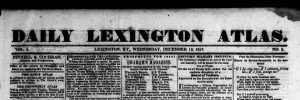
The Daily Lexington Atlas ran from December 11, 1847 through November 20, 1848 and was Lexington’s first daily paper, and the first to publish information from the telegraph lines. It was…
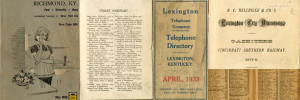
The library has a variety of directories and yearbooks with local information. In the library's current digital collection, there is a selection of residential and street directories, yearbooks,…
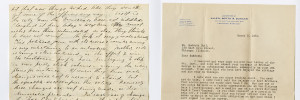
Various objects found in our Duncan-Goff scrapbook collection.
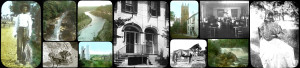
Elmer L. Foote served as official photographer of the Cincinnati Public Library for many years, and produced photographs that appeared in the Cincinnati Commercial Tribune …
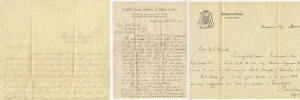
Letters from and/or about Father William T. Punch and the Punch family. Donated by a Lexington resident to Lexington Public Library. Father Punch was instrumental in building…

Until 1974, Lexington and Fayette County had two separate governing bodies. Lexington itself was founded in 1775 and chartered in 1782 by an act of the Virginia General Assembly,…
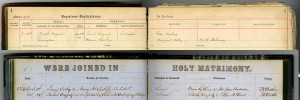
The St. Paul Catholic Church Collection includes materials from the Church's archive. The Roman Catholic church is over 150 years old, and is located on West Short Street, in downtown Lexington.…
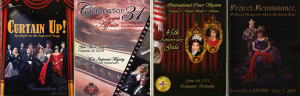
Founded in 1982 by Gigi Galore (Greg Butler) and Blanche Pink (Marlon Austin), the Imperial Court of Kentucky, Inc., is a nonprofit charity that supports the LGBTQ+ community of…
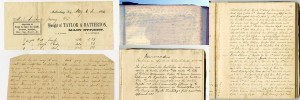
The Judge Kenneth Lyons collection consists of an atlas, a journal, and letters. The atlas features copies of letters written on the blank pages of the atlas. The journal contains family and local…
The Junior League of Lexington (JLL) is a local nonprofit organization of women committed to improving community through volunteerism. The first Junior League was established in 1901…
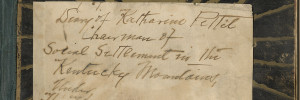
The diary (ca. 1899) of Katherine Pettit, details her settlement work for the Kentucky Confederation of Women's Clubs, made yearly trips to Hazard during this period and was a central figure in…
The Dunn Photograph Collection contains images of Lexington, KY taken in the 1960s and 1980s. Keller J. Dunn (1917-2000) born in Lexington, KY, shot hundreds of pictures of…
The library's collection contains many event pamphlets for Lexington and Kentucky counties, including county anniversary celebrations, suffragette songs, chautauquas, and community events and…
The photographs in the library's collection are donated from a variety of individuals.
The Ashland-McDowell Collection shows an unknown gathering of friends and…
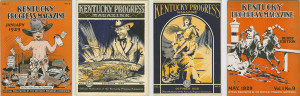
The Kentucky Progress Commission was formed in 1928 in order to draw tourism and business to Kentucky. It was formed by the Kentucky Legislature, and was a 12 person board. The “Kentucky…
The League of Women Voters of Lexington, Kentucky, was established in 1920. It is the local chapter of a national nonpartisan nonprofit organization that encourages informed and…
The Lexington History Museum began in 1998, and opened its doors in the Old Courthouse in 2003. Its purpose is to educate Fayette County about its rich history, and preserve pieces of that history…
The Lexington Public Library opened a Carnegie library in 1905. It incorporated the collections of the former subscription Lexington Library Company (est.1801) and the former…
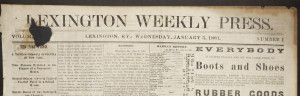
The Lexington Weekly Press was published every Wednesday in Lexington, Kentucky, and contained local, state, and foreign news. The paper focused on Central Kentucky’s “agriculture,…
The military history collection contains relevant histories and records that focus on Kentuckians involved at home and abroad, and includes a collection of United States Army Training Center…
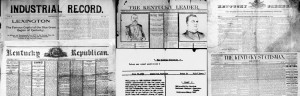
The Micellaneous Newspaper collection combines scattered issues of various historic newspapers in our archive collection.
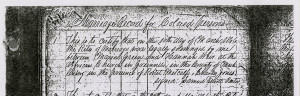
Scans of the Black Marriage records from the Courthouse in Greenville, Kentucky.
The collection contains various postcards featuring places in and around Kentucky and includes a selection donated by the Knowles family. The postcards in the library's collection were donated by…
This is a handwritten series of lectures detailing Samuel D. McCullough's memories of his childhood and life in Lexington, Kentucky, accompanied by letters and a photograph of his house. The…
The Schools and Yearbooks collection contains historical and modern yearbooks and other school documents owned by and donated to the Lexington Public Library.
The Daily Argonaut began in 1895 and seems to have ceased publication in 1899. This collection includes scattered issues from 1896, 1897 and 1898. The paper focuses more on sensational news and…
The Independent Gazetteer was founded and printed by James Charless in 1803, with ads appearing in the Kentucky Gazette about its upcoming…

The Kentucky Gazette was the first paper established west of the Allegheny Mountains, founded by John and Fielding Bradford. The frontier paper focused on East Coast and International news,…
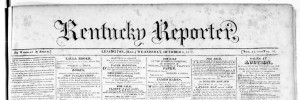
The Kentucky Reporter was published from October 1817-April 1832, by William W. Worsley and Thomas Smith. It is the direct continuation of the The Reporter. Politically, it was a…
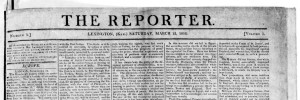
The Reporter was published from March 1808-September 1817, by William W. Worsley. It was a Republican paper (Jeffersonian Democratic Republican - liberal at the time). The paper was published…
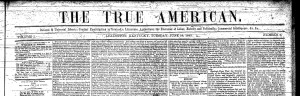
The True American was an anti-slavery newspaper started by Cassius Marcellus Clay in June 1845. He ran the paper in Lexington until August of 1845, when he published an…
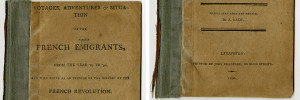
This work contains information about French Emigrants to America over the years 1789-1799, and provides a history of the French Revolution. The work was originally in French, and was translated…
Kentucky Events Collection
The library's collection contains many event pamphlets for Lexington and Kentucky counties, including county anniversary celebrations, suffragette songs, chautauquas, and community events and pageants.
All Digital Archives Collections
The first Kentucky almanacs were printed by John Bradford, on the same printing press that published the Kentucky Gazette. The Kentucky almanacs in the library's…
Fayette County's buildings contain a great deal of history about the region and its inhabitants. The earliest structure in Lexington was built in 1779, the Blockhouse. Lexington currently has over…
The collection consists of an image, homemade brochures, flyers, pamphlets, and programs covering LGBTQ+ events and places from 1983 to 1999 in both Lexington and Louisville. Subjects include…
The Bath County Memorial Library was founded in 1949 by the Owingsville Women’s Club, and opened in January, 1950. It expanded into a bookmobile in 1953, and in 1963 moved into the old Farmer’s…
The Black Community News Collection compiles searchable newspaper articles and ads for local Black community events, schools, social gatherings, church events, obituaries, and wedding…
The Brown-Hocker Collection is a community collection of photos and realia from African American events and people in Lexington and Kentucky history.
The objects in the collection are…
This collection contains materials from Lexington and Fayette County religious groups.
Compiled by Cyrus Parker Jones, a man formerly enslaved by the Parker family, these funeral notices cover 667 funerals of individuals in Lexington, including seven free blacks. The funeral notices…
The Daily Lexington Atlas ran from December 11, 1847 through November 20, 1848 and was Lexington’s first daily paper, and the first to publish information from the telegraph lines. It was…
The library has a variety of directories and yearbooks with local information. In the library's current digital collection, there is a selection of residential and street directories, yearbooks,…
Various objects found in our Duncan-Goff scrapbook collection.
Elmer L. Foote served as official photographer of the Cincinnati Public Library for many years, and produced photographs that appeared in the Cincinnati Commercial Tribune …
Letters from and/or about Father William T. Punch and the Punch family. Donated by a Lexington resident to Lexington Public Library. Father Punch was instrumental in building…
Until 1974, Lexington and Fayette County had two separate governing bodies. Lexington itself was founded in 1775 and chartered in 1782 by an act of the Virginia General Assembly,…
The St. Paul Catholic Church Collection includes materials from the Church's archive. The Roman Catholic church is over 150 years old, and is located on West Short Street, in downtown Lexington.…
Founded in 1982 by Gigi Galore (Greg Butler) and Blanche Pink (Marlon Austin), the Imperial Court of Kentucky, Inc., is a nonprofit charity that supports the LGBTQ+ community of…
The Judge Kenneth Lyons collection consists of an atlas, a journal, and letters. The atlas features copies of letters written on the blank pages of the atlas. The journal contains family and local…
The Junior League of Lexington (JLL) is a local nonprofit organization of women committed to improving community through volunteerism. The first Junior League was established in 1901…
The diary (ca. 1899) of Katherine Pettit, details her settlement work for the Kentucky Confederation of Women's Clubs, made yearly trips to Hazard during this period and was a central figure in…
The Dunn Photograph Collection contains images of Lexington, KY taken in the 1960s and 1980s. Keller J. Dunn (1917-2000) born in Lexington, KY, shot hundreds of pictures of…
The library's collection contains many event pamphlets for Lexington and Kentucky counties, including county anniversary celebrations, suffragette songs, chautauquas, and community events and…
The photographs in the library's collection are donated from a variety of individuals.
The Ashland-McDowell Collection shows an unknown gathering of friends and…
The Kentucky Progress Commission was formed in 1928 in order to draw tourism and business to Kentucky. It was formed by the Kentucky Legislature, and was a 12 person board. The “Kentucky…
The League of Women Voters of Lexington, Kentucky, was established in 1920. It is the local chapter of a national nonpartisan nonprofit organization that encourages informed and…
The Lexington History Museum began in 1998, and opened its doors in the Old Courthouse in 2003. Its purpose is to educate Fayette County about its rich history, and preserve pieces of that history…
The Lexington Public Library opened a Carnegie library in 1905. It incorporated the collections of the former subscription Lexington Library Company (est.1801) and the former…
The Lexington Weekly Press was published every Wednesday in Lexington, Kentucky, and contained local, state, and foreign news. The paper focused on Central Kentucky’s “agriculture,…
The military history collection contains relevant histories and records that focus on Kentuckians involved at home and abroad, and includes a collection of United States Army Training Center…
The Micellaneous Newspaper collection combines scattered issues of various historic newspapers in our archive collection.
Scans of the Black Marriage records from the Courthouse in Greenville, Kentucky.
The collection contains various postcards featuring places in and around Kentucky and includes a selection donated by the Knowles family. The postcards in the library's collection were donated by…
This is a handwritten series of lectures detailing Samuel D. McCullough's memories of his childhood and life in Lexington, Kentucky, accompanied by letters and a photograph of his house. The…
The Schools and Yearbooks collection contains historical and modern yearbooks and other school documents owned by and donated to the Lexington Public Library.
The Daily Argonaut began in 1895 and seems to have ceased publication in 1899. This collection includes scattered issues from 1896, 1897 and 1898. The paper focuses more on sensational news and…
The Independent Gazetteer was founded and printed by James Charless in 1803, with ads appearing in the Kentucky Gazette about its upcoming…
The Kentucky Gazette was the first paper established west of the Allegheny Mountains, founded by John and Fielding Bradford. The frontier paper focused on East Coast and International news,…
The Kentucky Reporter was published from October 1817-April 1832, by William W. Worsley and Thomas Smith. It is the direct continuation of the The Reporter. Politically, it was a…
The Reporter was published from March 1808-September 1817, by William W. Worsley. It was a Republican paper (Jeffersonian Democratic Republican - liberal at the time). The paper was published…
The True American was an anti-slavery newspaper started by Cassius Marcellus Clay in June 1845. He ran the paper in Lexington until August of 1845, when he published an…
This work contains information about French Emigrants to America over the years 1789-1799, and provides a history of the French Revolution. The work was originally in French, and was translated…
The Kentucky Gazette (1787-1840)

The Kentucky Gazette was the first paper established west of the Allegheny Mountains, founded by John and Fielding Bradford. The frontier paper focused on East Coast and International news, though some local announcements can be found. Later, the paper focused on disseminating opinions on politics and issues of concern on the frontier. When political parties emerged, the paper developed a Democratic (conservative at the time) bent. John Bradford handed the reins of the paper over to his son, Daniel Bradford, in 1802.
While still owned and occasionally edited by the Bradford family, the paper had several editors and publishers through the mid-1830s, when Daniel Bradford returned to the paper’s byline as editor. Daniel Bradford edited the paper until 1840, when he sold it to Jim Cunningham. The paper shuttered in 1848, due to Cunningham’s failing health, but was revived in 1866 and published until 1910 by different publishers.
The years 1841-1910 are not digitized as of January 2020, but are viewable on microfilm and in print in the Kentucky Room at Central Library. Selected articles are indexed in the Library’s Local History Index.
The Kentucky Room’s collection of The Kentucky Gazette is not complete. Here is a list of what is missing from the digitized collection:
1788: April 5, May 31, September 20
1789: All of May
1790: August 9 – November 27, December 27
1791: April 2, July 30, All of August, September 3, 10, 24, October 1
1792: April 2, September 15 - November 17
1793: May 4, June 15, July 20
1794: May 24, June 21, August 9 – September 13
1795: March 21, August 29, September 5, 12, 26, October 17
1807: Entire Year
1808: Entire Year
1821: January 26, February 1, 9, 16, March 29, April 5, May 3, 17, 24, 31, All of June, July 5, 19, August 9, 23, 30, September 20, October 18-December 27
1822: Entire Year
1823: Entire Year
1824: Entire Year
1827: Entire Year
1828: Entire Year
1829: Entire Year
1830: Entire Year
1831: Entire Year
1832: Entire Year
1833: Entire Year
1834: Entire Year
All Digital Archives Collections
The first Kentucky almanacs were printed by John Bradford, on the same printing press that published the Kentucky Gazette. The Kentucky almanacs in the library's…
Fayette County's buildings contain a great deal of history about the region and its inhabitants. The earliest structure in Lexington was built in 1779, the Blockhouse. Lexington currently has over…
The collection consists of an image, homemade brochures, flyers, pamphlets, and programs covering LGBTQ+ events and places from 1983 to 1999 in both Lexington and Louisville. Subjects include…
The Bath County Memorial Library was founded in 1949 by the Owingsville Women’s Club, and opened in January, 1950. It expanded into a bookmobile in 1953, and in 1963 moved into the old Farmer’s…
The Black Community News Collection compiles searchable newspaper articles and ads for local Black community events, schools, social gatherings, church events, obituaries, and wedding…
The Brown-Hocker Collection is a community collection of photos and realia from African American events and people in Lexington and Kentucky history.
The objects in the collection are…
This collection contains materials from Lexington and Fayette County religious groups.
Compiled by Cyrus Parker Jones, a man formerly enslaved by the Parker family, these funeral notices cover 667 funerals of individuals in Lexington, including seven free blacks. The funeral notices…
The Daily Lexington Atlas ran from December 11, 1847 through November 20, 1848 and was Lexington’s first daily paper, and the first to publish information from the telegraph lines. It was…
The library has a variety of directories and yearbooks with local information. In the library's current digital collection, there is a selection of residential and street directories, yearbooks,…
Various objects found in our Duncan-Goff scrapbook collection.
Elmer L. Foote served as official photographer of the Cincinnati Public Library for many years, and produced photographs that appeared in the Cincinnati Commercial Tribune …
Letters from and/or about Father William T. Punch and the Punch family. Donated by a Lexington resident to Lexington Public Library. Father Punch was instrumental in building…
Until 1974, Lexington and Fayette County had two separate governing bodies. Lexington itself was founded in 1775 and chartered in 1782 by an act of the Virginia General Assembly,…
The St. Paul Catholic Church Collection includes materials from the Church's archive. The Roman Catholic church is over 150 years old, and is located on West Short Street, in downtown Lexington.…
Founded in 1982 by Gigi Galore (Greg Butler) and Blanche Pink (Marlon Austin), the Imperial Court of Kentucky, Inc., is a nonprofit charity that supports the LGBTQ+ community of…
The Judge Kenneth Lyons collection consists of an atlas, a journal, and letters. The atlas features copies of letters written on the blank pages of the atlas. The journal contains family and local…
The Junior League of Lexington (JLL) is a local nonprofit organization of women committed to improving community through volunteerism. The first Junior League was established in 1901…
The diary (ca. 1899) of Katherine Pettit, details her settlement work for the Kentucky Confederation of Women's Clubs, made yearly trips to Hazard during this period and was a central figure in…
The Dunn Photograph Collection contains images of Lexington, KY taken in the 1960s and 1980s. Keller J. Dunn (1917-2000) born in Lexington, KY, shot hundreds of pictures of…
The library's collection contains many event pamphlets for Lexington and Kentucky counties, including county anniversary celebrations, suffragette songs, chautauquas, and community events and…
The photographs in the library's collection are donated from a variety of individuals.
The Ashland-McDowell Collection shows an unknown gathering of friends and…
The Kentucky Progress Commission was formed in 1928 in order to draw tourism and business to Kentucky. It was formed by the Kentucky Legislature, and was a 12 person board. The “Kentucky…
The League of Women Voters of Lexington, Kentucky, was established in 1920. It is the local chapter of a national nonpartisan nonprofit organization that encourages informed and…
The Lexington History Museum began in 1998, and opened its doors in the Old Courthouse in 2003. Its purpose is to educate Fayette County about its rich history, and preserve pieces of that history…
The Lexington Public Library opened a Carnegie library in 1905. It incorporated the collections of the former subscription Lexington Library Company (est.1801) and the former…
The Lexington Weekly Press was published every Wednesday in Lexington, Kentucky, and contained local, state, and foreign news. The paper focused on Central Kentucky’s “agriculture,…
The military history collection contains relevant histories and records that focus on Kentuckians involved at home and abroad, and includes a collection of United States Army Training Center…
The Micellaneous Newspaper collection combines scattered issues of various historic newspapers in our archive collection.
Scans of the Black Marriage records from the Courthouse in Greenville, Kentucky.
The collection contains various postcards featuring places in and around Kentucky and includes a selection donated by the Knowles family. The postcards in the library's collection were donated by…
This is a handwritten series of lectures detailing Samuel D. McCullough's memories of his childhood and life in Lexington, Kentucky, accompanied by letters and a photograph of his house. The…
The Schools and Yearbooks collection contains historical and modern yearbooks and other school documents owned by and donated to the Lexington Public Library.
The Daily Argonaut began in 1895 and seems to have ceased publication in 1899. This collection includes scattered issues from 1896, 1897 and 1898. The paper focuses more on sensational news and…
The Independent Gazetteer was founded and printed by James Charless in 1803, with ads appearing in the Kentucky Gazette about its upcoming…
The Kentucky Gazette was the first paper established west of the Allegheny Mountains, founded by John and Fielding Bradford. The frontier paper focused on East Coast and International news,…
The Kentucky Reporter was published from October 1817-April 1832, by William W. Worsley and Thomas Smith. It is the direct continuation of the The Reporter. Politically, it was a…
The Reporter was published from March 1808-September 1817, by William W. Worsley. It was a Republican paper (Jeffersonian Democratic Republican - liberal at the time). The paper was published…
The True American was an anti-slavery newspaper started by Cassius Marcellus Clay in June 1845. He ran the paper in Lexington until August of 1845, when he published an…
This work contains information about French Emigrants to America over the years 1789-1799, and provides a history of the French Revolution. The work was originally in French, and was translated…
Discover everything that's happening this summer at the library!
Monday-Thursday: 9:30am-7:00pm
Friday: 9:30am-6:00pm
Saturday: 9:30am-5:00pm
Sunday: 1:00pm-5:00pm
1733 Russell Cave Road
Lexington, KY 40505
Black Community News
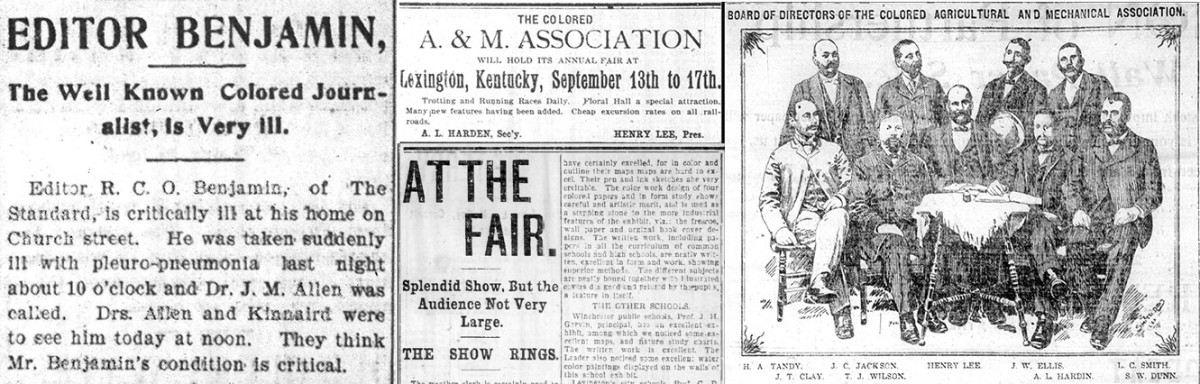
The Black Community News Collection compiles searchable newspaper articles and ads for local Black community events, schools, social gatherings, church events, obituaries, and wedding announcements in older local newspapers in the library’s collection. In addition to Lexington news, the articles contain information about people in many surrounding communities, as well.
In 1898, Lexington’s evening paper, the Leader* began publishing specific news columns about the local Black community and society events. Early columns were scattered and not consistently named; they were titled “Weldon” or “Welden” after the first Black columnist, “In Colored Circles,” “In Colored Society,” and later, became a more standard column titled, “Colored News” and “Colored Notes.” The other local paper, the morning Herald, began publishing a similar column in the 1920s. Lexington at that time had a weekly Black newspaper, the Lexington Standard, that ran from 1892-1912, when it briefly became the Lexington Weekly News before it folded.
The first reporter/columnist of Black social news in the Leader was John Weldon Jewett, a local educator later appointed to the IRS; he would often sign announcements with “Weldon” or “Welden” or “JW.” After his death in 1905, columns were contributed by William Henry Ballard, who opened the first Black pharmacy in Kentucky in 1893, and others. In 1925, the Herald appointed a separate department managed by Lucy J. Cochran, which was housed separately from the general newspaper office, and after multiple editors, D. I. Reid took over in 1934 and ran it until his death in 1950.
Community groups began to challenge the term “colored” and the “Colored Notes” being a separate news column in the 1950s, but Black community news was not integrated with the rest of the newspaper until 1969.
The only surviving issues of the Lexington Standard and the Lexington Weekly News can be found on Chronicling America.
Information about the Lexington newspapers and early Black editors was compiled from:
NKAA Database entry “Colored Circles, Colored News Notes, Colored News, General Colored News, and Colored Notes (Lexington Newspapers)”
Biographical sketches of prominent Negro men and women of Kentucky by W. D. Johnson, (1897)
*The Leader began as the Kentucky Leader in 1888, and several years later became the Daily Leader and the Sunday editions labeled as The Sunday Leader. It became the Lexington Leader in 1901, began sharing Sundays with the Lexington Herald in the 1950s, and eventually fully combined with the Herald to become the Lexington Herald-Leader in 1983.
Collection Content
Years Available:
The Leader: 1898, 1899
All Digital Archives Collections
The first Kentucky almanacs were printed by John Bradford, on the same printing press that published the Kentucky Gazette. The Kentucky almanacs in the library's…
Fayette County's buildings contain a great deal of history about the region and its inhabitants. The earliest structure in Lexington was built in 1779, the Blockhouse. Lexington currently has over…
The collection consists of an image, homemade brochures, flyers, pamphlets, and programs covering LGBTQ+ events and places from 1983 to 1999 in both Lexington and Louisville. Subjects include…
The Bath County Memorial Library was founded in 1949 by the Owingsville Women’s Club, and opened in January, 1950. It expanded into a bookmobile in 1953, and in 1963 moved into the old Farmer’s…
The Black Community News Collection compiles searchable newspaper articles and ads for local Black community events, schools, social gatherings, church events, obituaries, and wedding…
The Brown-Hocker Collection is a community collection of photos and realia from African American events and people in Lexington and Kentucky history.
The objects in the collection are…
This collection contains materials from Lexington and Fayette County religious groups.
Compiled by Cyrus Parker Jones, a man formerly enslaved by the Parker family, these funeral notices cover 667 funerals of individuals in Lexington, including seven free blacks. The funeral notices…
The Daily Lexington Atlas ran from December 11, 1847 through November 20, 1848 and was Lexington’s first daily paper, and the first to publish information from the telegraph lines. It was…
The library has a variety of directories and yearbooks with local information. In the library's current digital collection, there is a selection of residential and street directories, yearbooks,…
Various objects found in our Duncan-Goff scrapbook collection.
Elmer L. Foote served as official photographer of the Cincinnati Public Library for many years, and produced photographs that appeared in the Cincinnati Commercial Tribune …
Letters from and/or about Father William T. Punch and the Punch family. Donated by a Lexington resident to Lexington Public Library. Father Punch was instrumental in building…
Until 1974, Lexington and Fayette County had two separate governing bodies. Lexington itself was founded in 1775 and chartered in 1782 by an act of the Virginia General Assembly,…
The St. Paul Catholic Church Collection includes materials from the Church's archive. The Roman Catholic church is over 150 years old, and is located on West Short Street, in downtown Lexington.…
Founded in 1982 by Gigi Galore (Greg Butler) and Blanche Pink (Marlon Austin), the Imperial Court of Kentucky, Inc., is a nonprofit charity that supports the LGBTQ+ community of…
The Judge Kenneth Lyons collection consists of an atlas, a journal, and letters. The atlas features copies of letters written on the blank pages of the atlas. The journal contains family and local…
The Junior League of Lexington (JLL) is a local nonprofit organization of women committed to improving community through volunteerism. The first Junior League was established in 1901…
The diary (ca. 1899) of Katherine Pettit, details her settlement work for the Kentucky Confederation of Women's Clubs, made yearly trips to Hazard during this period and was a central figure in…
The Dunn Photograph Collection contains images of Lexington, KY taken in the 1960s and 1980s. Keller J. Dunn (1917-2000) born in Lexington, KY, shot hundreds of pictures of…
The library's collection contains many event pamphlets for Lexington and Kentucky counties, including county anniversary celebrations, suffragette songs, chautauquas, and community events and…
The photographs in the library's collection are donated from a variety of individuals.
The Ashland-McDowell Collection shows an unknown gathering of friends and…
The Kentucky Progress Commission was formed in 1928 in order to draw tourism and business to Kentucky. It was formed by the Kentucky Legislature, and was a 12 person board. The “Kentucky…
The League of Women Voters of Lexington, Kentucky, was established in 1920. It is the local chapter of a national nonpartisan nonprofit organization that encourages informed and…
The Lexington History Museum began in 1998, and opened its doors in the Old Courthouse in 2003. Its purpose is to educate Fayette County about its rich history, and preserve pieces of that history…
The Lexington Public Library opened a Carnegie library in 1905. It incorporated the collections of the former subscription Lexington Library Company (est.1801) and the former…
The Lexington Weekly Press was published every Wednesday in Lexington, Kentucky, and contained local, state, and foreign news. The paper focused on Central Kentucky’s “agriculture,…
The military history collection contains relevant histories and records that focus on Kentuckians involved at home and abroad, and includes a collection of United States Army Training Center…
The Micellaneous Newspaper collection combines scattered issues of various historic newspapers in our archive collection.
Scans of the Black Marriage records from the Courthouse in Greenville, Kentucky.
The collection contains various postcards featuring places in and around Kentucky and includes a selection donated by the Knowles family. The postcards in the library's collection were donated by…
This is a handwritten series of lectures detailing Samuel D. McCullough's memories of his childhood and life in Lexington, Kentucky, accompanied by letters and a photograph of his house. The…
The Schools and Yearbooks collection contains historical and modern yearbooks and other school documents owned by and donated to the Lexington Public Library.
The Daily Argonaut began in 1895 and seems to have ceased publication in 1899. This collection includes scattered issues from 1896, 1897 and 1898. The paper focuses more on sensational news and…
The Independent Gazetteer was founded and printed by James Charless in 1803, with ads appearing in the Kentucky Gazette about its upcoming…
The Kentucky Gazette was the first paper established west of the Allegheny Mountains, founded by John and Fielding Bradford. The frontier paper focused on East Coast and International news,…
The Kentucky Reporter was published from October 1817-April 1832, by William W. Worsley and Thomas Smith. It is the direct continuation of the The Reporter. Politically, it was a…
The Reporter was published from March 1808-September 1817, by William W. Worsley. It was a Republican paper (Jeffersonian Democratic Republican - liberal at the time). The paper was published…
The True American was an anti-slavery newspaper started by Cassius Marcellus Clay in June 1845. He ran the paper in Lexington until August of 1845, when he published an…
This work contains information about French Emigrants to America over the years 1789-1799, and provides a history of the French Revolution. The work was originally in French, and was translated…
The True American (1845-1847)
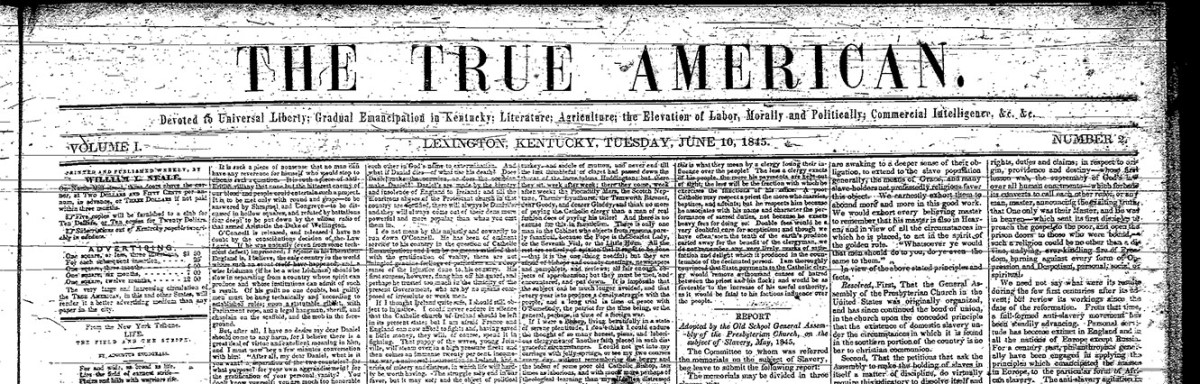
The True American was an anti-slavery newspaper started by Cassius Marcellus Clay in June 1845. He ran the paper in Lexington until August of 1845, when he published an article deemed so incendiary that a court injunction was issued against his printing, and his press shipped to Cincinnati. An advocate of the right to a free press, and his right of free speech, Clay continued printing the paper through 1847 in Cincinnati. The paper was distributed in Lexington. While focused on advancing the cause of emancipation, Clay also published poetry, agriculture, labor, and commercial news. There are also marriage and death notices from the surrounding area, some national.
Cassius Marcellus Clay was a fiery figure in Kentucky history. He often fought in duels and in street fights, generally in response to arguments against his emancipationist views. Later in life, he often had shootouts with the Madison County Sheriff at his home, Whitehall.
After the publication of his incendiary editorial (August 12, 1845, page 3 columns 1-4), he is said to have armed his printing shop with two brass cannons and myriad other weapons to fend off any attacks. The committee charged with removing his press did so while Clay was incapacitated with a fever, avoiding what surely would have been a deadly counterattack from Clay. In the March 18, 1846 paper, Clay addresses the attack, and continues his fiery rhetoric, finally offering a discount to non-slaveholders in slave states.
Clay is featured in an episode of the Library’s podcast "Tales from the Kentucky Room", which is linked below.
The Library only has a short run of The True American. It has been digitized from the microfilm, which can be accessed in the Kentucky Room. Several issues have significant mildew damage, so in some cases the OCR quality may be poor, though the print itself is still legible.
- Listen to our interview with Tom Eblen about Kentucky Newspapers
- Listen to our podcast episode about Cassius Marcellus Clay
Issues available in the Library's Collection:
1845:
June 3
June 10
June 17
June 24
July 1
July 8
July 15
July 22
July 29
August 5
August 12
August 19 (missing pages 3 & 4) – The printing office was sacked on August 18.
1846:
March 18
All Digital Archives Collections
The first Kentucky almanacs were printed by John Bradford, on the same printing press that published the Kentucky Gazette. The Kentucky almanacs in the library's…
Fayette County's buildings contain a great deal of history about the region and its inhabitants. The earliest structure in Lexington was built in 1779, the Blockhouse. Lexington currently has over…
The collection consists of an image, homemade brochures, flyers, pamphlets, and programs covering LGBTQ+ events and places from 1983 to 1999 in both Lexington and Louisville. Subjects include…
The Bath County Memorial Library was founded in 1949 by the Owingsville Women’s Club, and opened in January, 1950. It expanded into a bookmobile in 1953, and in 1963 moved into the old Farmer’s…
The Black Community News Collection compiles searchable newspaper articles and ads for local Black community events, schools, social gatherings, church events, obituaries, and wedding…
The Brown-Hocker Collection is a community collection of photos and realia from African American events and people in Lexington and Kentucky history.
The objects in the collection are…
This collection contains materials from Lexington and Fayette County religious groups.
Compiled by Cyrus Parker Jones, a man formerly enslaved by the Parker family, these funeral notices cover 667 funerals of individuals in Lexington, including seven free blacks. The funeral notices…
The Daily Lexington Atlas ran from December 11, 1847 through November 20, 1848 and was Lexington’s first daily paper, and the first to publish information from the telegraph lines. It was…
The library has a variety of directories and yearbooks with local information. In the library's current digital collection, there is a selection of residential and street directories, yearbooks,…
Various objects found in our Duncan-Goff scrapbook collection.
Elmer L. Foote served as official photographer of the Cincinnati Public Library for many years, and produced photographs that appeared in the Cincinnati Commercial Tribune …
Letters from and/or about Father William T. Punch and the Punch family. Donated by a Lexington resident to Lexington Public Library. Father Punch was instrumental in building…
Until 1974, Lexington and Fayette County had two separate governing bodies. Lexington itself was founded in 1775 and chartered in 1782 by an act of the Virginia General Assembly,…
The St. Paul Catholic Church Collection includes materials from the Church's archive. The Roman Catholic church is over 150 years old, and is located on West Short Street, in downtown Lexington.…
Founded in 1982 by Gigi Galore (Greg Butler) and Blanche Pink (Marlon Austin), the Imperial Court of Kentucky, Inc., is a nonprofit charity that supports the LGBTQ+ community of…
The Judge Kenneth Lyons collection consists of an atlas, a journal, and letters. The atlas features copies of letters written on the blank pages of the atlas. The journal contains family and local…
The Junior League of Lexington (JLL) is a local nonprofit organization of women committed to improving community through volunteerism. The first Junior League was established in 1901…
The diary (ca. 1899) of Katherine Pettit, details her settlement work for the Kentucky Confederation of Women's Clubs, made yearly trips to Hazard during this period and was a central figure in…
The Dunn Photograph Collection contains images of Lexington, KY taken in the 1960s and 1980s. Keller J. Dunn (1917-2000) born in Lexington, KY, shot hundreds of pictures of…
The library's collection contains many event pamphlets for Lexington and Kentucky counties, including county anniversary celebrations, suffragette songs, chautauquas, and community events and…
The photographs in the library's collection are donated from a variety of individuals.
The Ashland-McDowell Collection shows an unknown gathering of friends and…
The Kentucky Progress Commission was formed in 1928 in order to draw tourism and business to Kentucky. It was formed by the Kentucky Legislature, and was a 12 person board. The “Kentucky…
The League of Women Voters of Lexington, Kentucky, was established in 1920. It is the local chapter of a national nonpartisan nonprofit organization that encourages informed and…
The Lexington History Museum began in 1998, and opened its doors in the Old Courthouse in 2003. Its purpose is to educate Fayette County about its rich history, and preserve pieces of that history…
The Lexington Public Library opened a Carnegie library in 1905. It incorporated the collections of the former subscription Lexington Library Company (est.1801) and the former…
The Lexington Weekly Press was published every Wednesday in Lexington, Kentucky, and contained local, state, and foreign news. The paper focused on Central Kentucky’s “agriculture,…
The military history collection contains relevant histories and records that focus on Kentuckians involved at home and abroad, and includes a collection of United States Army Training Center…
The Micellaneous Newspaper collection combines scattered issues of various historic newspapers in our archive collection.
Scans of the Black Marriage records from the Courthouse in Greenville, Kentucky.
The collection contains various postcards featuring places in and around Kentucky and includes a selection donated by the Knowles family. The postcards in the library's collection were donated by…
This is a handwritten series of lectures detailing Samuel D. McCullough's memories of his childhood and life in Lexington, Kentucky, accompanied by letters and a photograph of his house. The…
The Schools and Yearbooks collection contains historical and modern yearbooks and other school documents owned by and donated to the Lexington Public Library.
The Daily Argonaut began in 1895 and seems to have ceased publication in 1899. This collection includes scattered issues from 1896, 1897 and 1898. The paper focuses more on sensational news and…
The Independent Gazetteer was founded and printed by James Charless in 1803, with ads appearing in the Kentucky Gazette about its upcoming…
The Kentucky Gazette was the first paper established west of the Allegheny Mountains, founded by John and Fielding Bradford. The frontier paper focused on East Coast and International news,…
The Kentucky Reporter was published from October 1817-April 1832, by William W. Worsley and Thomas Smith. It is the direct continuation of the The Reporter. Politically, it was a…
The Reporter was published from March 1808-September 1817, by William W. Worsley. It was a Republican paper (Jeffersonian Democratic Republican - liberal at the time). The paper was published…
The True American was an anti-slavery newspaper started by Cassius Marcellus Clay in June 1845. He ran the paper in Lexington until August of 1845, when he published an…
This work contains information about French Emigrants to America over the years 1789-1799, and provides a history of the French Revolution. The work was originally in French, and was translated…
This is your gateway to our most popular resources. Search for books and eBooks, access tools for research and learning, and discover our unique collection of genealogy and local history materials.

Elizabeth has been a member of the Lexington Police Department since 1998. After retiring from sworn duty in 2019, she returned to the department as a polygraph examiner and background investigator. In her current position, she coordinates with multiple divisions in the Urban County Government to ensure the fair hiring of qualified applicants.

Join librarians Alexa and Jenny as we talk books. What we're currently loving, what we're hating, and what we can't wait to read next!
The Luna Library, a program of Believing in Forever, collects and distributes children's books with an African American history or Black character focus. It is an alternative for African American parents looking for books that provide context and knowledge to understand the stories of the African American experience in this country for their children. Believing in Forever is a champion of diversity and inclusion, and the positive impact books have on children of all races.