







The first Kentucky almanacs were printed by John Bradford, on the same printing press that published the Kentucky Gazette. The Kentucky almanacs in the library's…

Your tax-deductible gift to the Lexington Public Library Foundation funds innovation in our public library system. We raise funds to support Lexington Public Library programs, services, and special projects that go beyond what public dollars alone can support, today and for generations to come. The Library Foundation will send you an email confirmation of your gift and a year-end summary and tax acknowledgement receipt.
The Central Kentucky Cemeteries Maps are powered by Google Maps. Counties include: Fayette, Bourbon, Clark, Garrard, Harrison, Jessamine, Lincoln, Madison, Mercer, Montgomery, Nicholas, Powell, Scott, and Woodford.

Get live expert help with homework and skill building, study tips and tools, and collaborate with friends on your computer or mobile device. Live Homework Help is available daily for K-12 grades with professional tutors. You must create an account on the Brainfuse site before you can log into the mobile app.

|

|

Want to learn or improve your skills in a new language? Ready to switch from the bird of prey with ominous reminders? Try Mango Languages to learn practical conversation skills in over 70 world languages on your computer or mobile device. Learn and practice English with ESL courses taught in more than 15 different languages. You must create an account on the Mango Languages site before you can log into the mobile app.
Languages You Can Learn!
|
|
|
 Delivers fast, easy and effective language learning wherever your travels take you. With free apps from Mango, you can access the same awesome courses when you’re on the go.
The Lexington Public Library is pleased to offer teachers, childcare providers, and homeschooling families the "Bucket of Books" service. We can supplement your curriculum with specially-selected books on a particular topic or provide your classroom with specially-selected books for your students' pleasure reading.
Have a question? Ask us! You can contact us via email, phone, chat, or text. Book a librarian for one-on-one help. Suggest a purchase to help us improve our collection.
The Lexington Public Library’s Digital Archives provide open access to researchers and students to learn more about the rich history of Lexington and Fayette County. It contains a fraction of the Library’s physical holdings, which are housed and available for reference in the Kentucky Room at the Central Library. New material is being digitized and added constantly, so there's always something new to find.
The Lexington Public Library allows access to its records, pursuant to KRS 61.870 to 61.884.
The Central Library's Parking Garage is available to our customers or anyone needing a parking space. There are 428 parking spots in the garage, 10 of which are handicapped or van accessible. The height clearance for garage entry is 13'1". The height clearance for parking access is 6'4".
Two hours of free parking is provided with a ticket validated inside the Central Library.
Teacher Time returns to the Marksbury Family Branch Makerspace July 13–17 and to the Eastside Makerspace July 20–24, with two sessions each day: 11:00am–2:00pm and 3:00pm–6:00pm.
Teacher Time is a free library program offering local educators dedicated hours and staff support to use Makerspace equipment for creating classroom resources.
National Library Card Sign-Up Month is an annual invitation to discover (or rediscover) all that a free library card has to offer. This year, with support from local business partners, your library card can also get you great deals at participating shops and restaurants throughout September.
Meet the Lexington Public Library's Board, Administrative Team, and Leadership Team. Apply to work or volunteer at the library.
Learning doesn’t stop at the end of the school day. The Lexington Public Library is here to support your education at every level, from birth through college, with skill-building tools, live tutoring, standardized test prep, after-school programs, and more.
Meet with a librarian for one-on-one consultation. Please submit the Book a Librarian Appointment Request Form or call 859-231-5500 during business hours to schedule an appointment. Appointments are scheduled Monday-Friday during Library business hours and typically last 30 to 45 minutes.
The Digital Studio provides people of all skill levels the equipment, software, and AI creative tools for filmmaking, photography and digital art, music making, and media preservation.
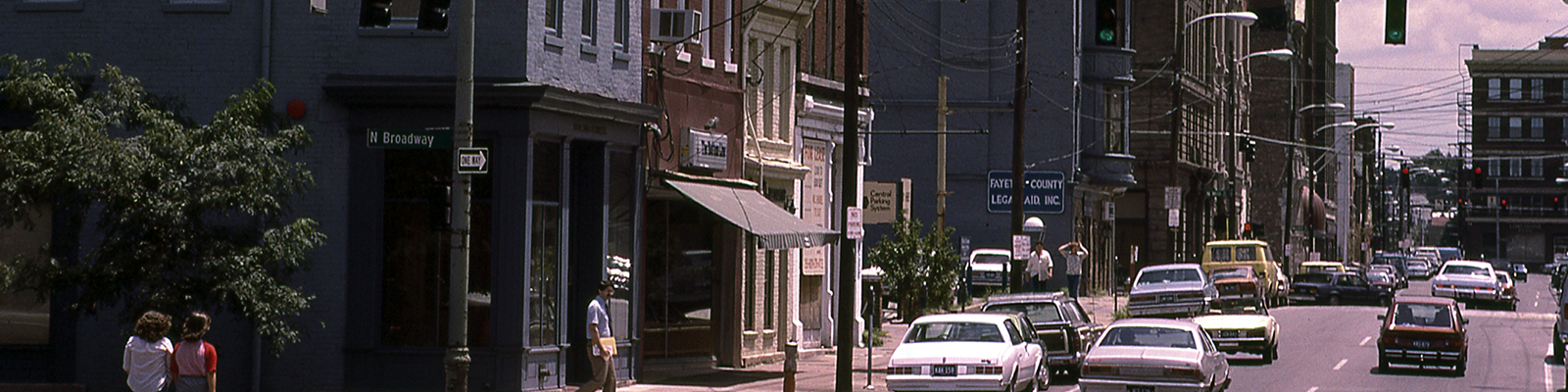
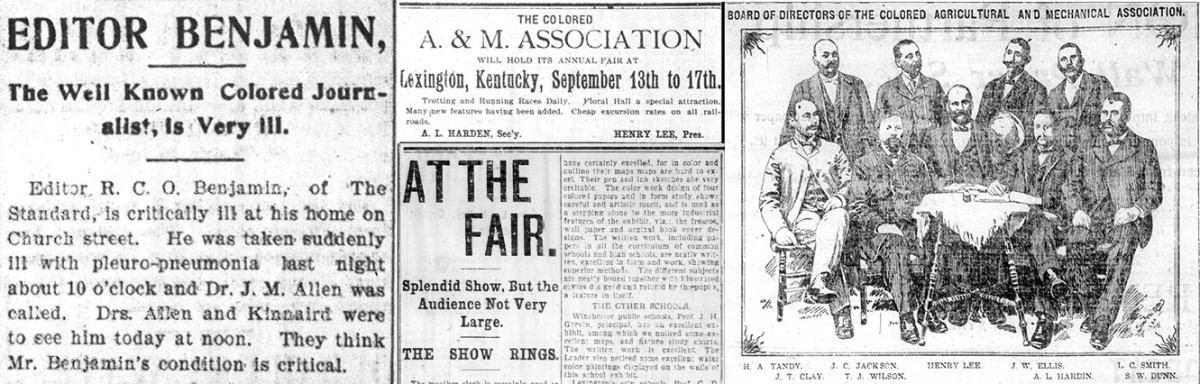
The Black Community News Collection compiles searchable newspaper articles and ads for local Black community events, schools, social gatherings, church events, obituaries, and wedding announcements in older local newspapers in the library’s collection. In addition to Lexington news, the articles contain information about people in many surrounding communities, as well.
In 1898, Lexington’s evening paper, the Leader* began publishing specific news columns about the local Black community and society events. Early columns were scattered and not consistently named; they were titled “Weldon” or “Welden” after the first Black columnist, “In Colored Circles,” “In Colored Society,” and later, became a more standard column titled, “Colored News” and “Colored Notes.” The other local paper, the morning Herald, began publishing a similar column in the 1920s. Lexington at that time had a weekly Black newspaper, the Lexington Standard, that ran from 1892-1912, when it briefly became the Lexington Weekly News before it folded.
The first reporter/columnist of Black social news in the Leader was John Weldon Jewett, a local educator later appointed to the IRS; he would often sign announcements with “Weldon” or “Welden” or “JW.” After his death in 1905, columns were contributed by William Henry Ballard, who opened the first Black pharmacy in Kentucky in 1893, and others. In 1925, the Herald appointed a separate department managed by Lucy J. Cochran, which was housed separately from the general newspaper office, and after multiple editors, D. I. Reid took over in 1934 and ran it until his death in 1950.
Community groups began to challenge the term “colored” and the “Colored Notes” being a separate news column in the 1950s, but Black community news was not integrated with the rest of the newspaper until 1969.
The only surviving issues of the Lexington Standard and the Lexington Weekly News can be found on Chronicling America.
Information about the Lexington newspapers and early Black editors was compiled from:
NKAA Database entry “Colored Circles, Colored News Notes, Colored News, General Colored News, and Colored Notes (Lexington Newspapers)”
Biographical sketches of prominent Negro men and women of Kentucky by W. D. Johnson, (1897)
*The Leader began as the Kentucky Leader in 1888, and several years later became the Daily Leader and the Sunday editions labeled as The Sunday Leader. It became the Lexington Leader in 1901, began sharing Sundays with the Lexington Herald in the 1950s, and eventually fully combined with the Herald to become the Lexington Herald-Leader in 1983.
Collection Content
Years Available:
The Leader: 1898, 1899
The first Kentucky almanacs were printed by John Bradford, on the same printing press that published the Kentucky Gazette. The Kentucky almanacs in the library's…
Fayette County's buildings contain a great deal of history about the region and its inhabitants. The earliest structure in Lexington was built in 1779, the Blockhouse. Lexington currently has over…
The collection consists of an image, homemade brochures, flyers, pamphlets, and programs covering LGBTQ+ events and places from 1983 to 1999 in both Lexington and Louisville. Subjects include…
The Bath County Memorial Library was founded in 1949 by the Owingsville Women’s Club, and opened in January, 1950. It expanded into a bookmobile in 1953, and in 1963 moved into the old Farmer’s…
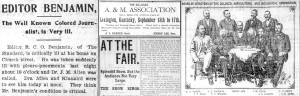
The Black Community News Collection compiles searchable newspaper articles and ads for local Black community events, schools, social gatherings, church events, obituaries, and wedding…
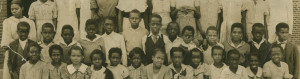
The Brown-Hocker Collection is a community collection of photos and realia from African American events and people in Lexington and Kentucky history.
The objects in the collection are…
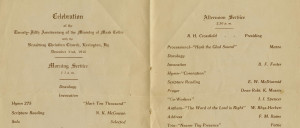
This collection contains materials from Lexington and Fayette County religious groups.
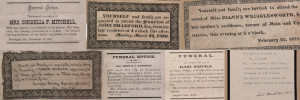
Compiled by Cyrus Parker Jones, a man formerly enslaved by the Parker family, these funeral notices cover 667 funerals of individuals in Lexington, including seven free blacks. The funeral notices…
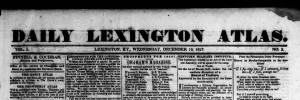
The Daily Lexington Atlas ran from December 11, 1847 through November 20, 1848 and was Lexington’s first daily paper, and the first to publish information from the telegraph lines. It was…
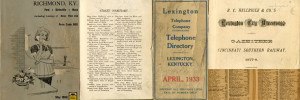
The library has a variety of directories and yearbooks with local information. In the library's current digital collection, there is a selection of residential and street directories, yearbooks,…
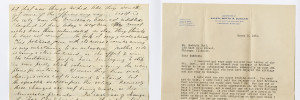
Various objects found in our Duncan-Goff scrapbook collection.
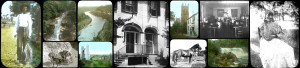
Elmer L. Foote served as official photographer of the Cincinnati Public Library for many years, and produced photographs that appeared in the Cincinnati Commercial Tribune …
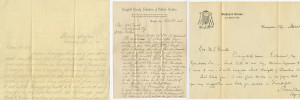
Letters from and/or about Father William T. Punch and the Punch family. Donated by a Lexington resident to Lexington Public Library. Father Punch was instrumental in building…

Until 1974, Lexington and Fayette County had two separate governing bodies. Lexington itself was founded in 1775 and chartered in 1782 by an act of the Virginia General Assembly,…
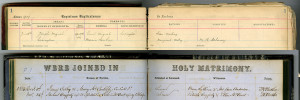
The St. Paul Catholic Church Collection includes materials from the Church's archive. The Roman Catholic church is over 150 years old, and is located on West Short Street, in downtown Lexington.…
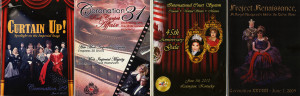
Founded in 1982 by Gigi Galore (Greg Butler) and Blanche Pink (Marlon Austin), the Imperial Court of Kentucky, Inc., is a nonprofit charity that supports the LGBTQ+ community of…
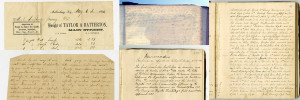
The Judge Kenneth Lyons collection consists of an atlas, a journal, and letters. The atlas features copies of letters written on the blank pages of the atlas. The journal contains family and local…
The Junior League of Lexington (JLL) is a local nonprofit organization of women committed to improving community through volunteerism. The first Junior League was established in 1901…
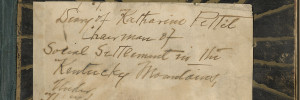
The diary (ca. 1899) of Katherine Pettit, details her settlement work for the Kentucky Confederation of Women's Clubs, made yearly trips to Hazard during this period and was a central figure in…
The Dunn Photograph Collection contains images of Lexington, KY taken in the 1960s and 1980s. Keller J. Dunn (1917-2000) born in Lexington, KY, shot hundreds of pictures of…
The library's collection contains many event pamphlets for Lexington and Kentucky counties, including county anniversary celebrations, suffragette songs, chautauquas, and community events and…
The photographs in the library's collection are donated from a variety of individuals.
The Ashland-McDowell Collection shows an unknown gathering of friends and…
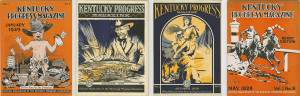
The Kentucky Progress Commission was formed in 1928 in order to draw tourism and business to Kentucky. It was formed by the Kentucky Legislature, and was a 12 person board. The “Kentucky…
The League of Women Voters of Lexington, Kentucky, was established in 1920. It is the local chapter of a national nonpartisan nonprofit organization that encourages informed and…
The Lexington History Museum began in 1998, and opened its doors in the Old Courthouse in 2003. Its purpose is to educate Fayette County about its rich history, and preserve pieces of that history…
The Lexington Public Library opened a Carnegie library in 1905. It incorporated the collections of the former subscription Lexington Library Company (est.1801) and the former…
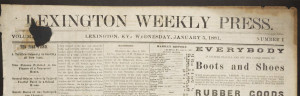
The Lexington Weekly Press was published every Wednesday in Lexington, Kentucky, and contained local, state, and foreign news. The paper focused on Central Kentucky’s “agriculture,…
The military history collection contains relevant histories and records that focus on Kentuckians involved at home and abroad, and includes a collection of United States Army Training Center…
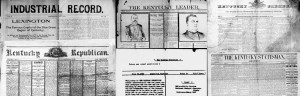
The Micellaneous Newspaper collection combines scattered issues of various historic newspapers in our archive collection.
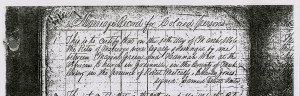
Scans of the Black Marriage records from the Courthouse in Greenville, Kentucky.
The collection contains various postcards featuring places in and around Kentucky and includes a selection donated by the Knowles family. The postcards in the library's collection were donated by…
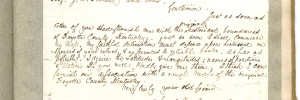
This is a handwritten series of lectures detailing Samuel D. McCullough's memories of his childhood and life in Lexington, Kentucky, accompanied by letters and a photograph of his house. The…
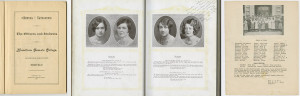
The Schools and Yearbooks collection contains historical and modern yearbooks and other school documents owned by and donated to the Lexington Public Library.
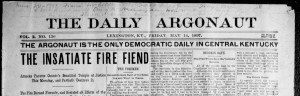
The Daily Argonaut began in 1895 and seems to have ceased publication in 1899. This collection includes scattered issues from 1896, 1897 and 1898. The paper focuses more on sensational news and…
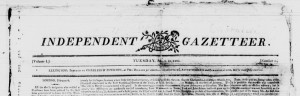
The Independent Gazetteer was founded and printed by James Charless in 1803, with ads appearing in the Kentucky Gazette about its upcoming…

The Kentucky Gazette was the first paper established west of the Allegheny Mountains, founded by John and Fielding Bradford. The frontier paper focused on East Coast and International news,…
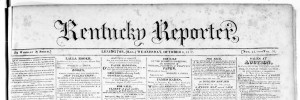
The Kentucky Reporter was published from October 1817-April 1832, by William W. Worsley and Thomas Smith. It is the direct continuation of the The Reporter. Politically, it was a…
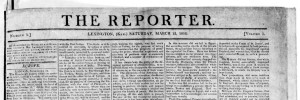
The Reporter was published from March 1808-September 1817, by William W. Worsley. It was a Republican paper (Jeffersonian Democratic Republican - liberal at the time). The paper was published…
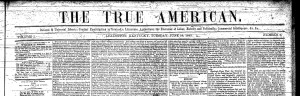
The True American was an anti-slavery newspaper started by Cassius Marcellus Clay in June 1845. He ran the paper in Lexington until August of 1845, when he published an…
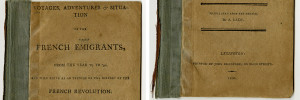
This work contains information about French Emigrants to America over the years 1789-1799, and provides a history of the French Revolution. The work was originally in French, and was translated…
Lexington, Kentucky (August 18, 2022) – The Lexington Public Library broke ground on a new, significantly larger facility in the former Village Branch location on Versailles Road to better provide for the needs of the neighborhoods it serves. The new branch will reflect the community’s vision for a state-of-the-art community hub, one that offers robust resources and a myriad of program and service offerings. The groundbreaking ceremony was held on Tuesday at a media event featuring Library and City officials.
The Materials Selection Policy was initially adopted February 25, 1987 by the Lexington Public Library Board of Trustees and was revised March 24, 1993. The Materials Selection Policy was updated and renamed the Collection Development Policy which was approved by the Board on January 14, 2009. The Board of Trustees assumes full responsibility for all legal actions which may result from the implementation of any policies stated herein.
Discover free events, books, and resources exploring Juneteenth, the holiday commemorating when the Emancipation Proclamation reached enslaved people in Galveston, Texas, in 1865.
Please note that all locations will be closed on June 19 in observance.
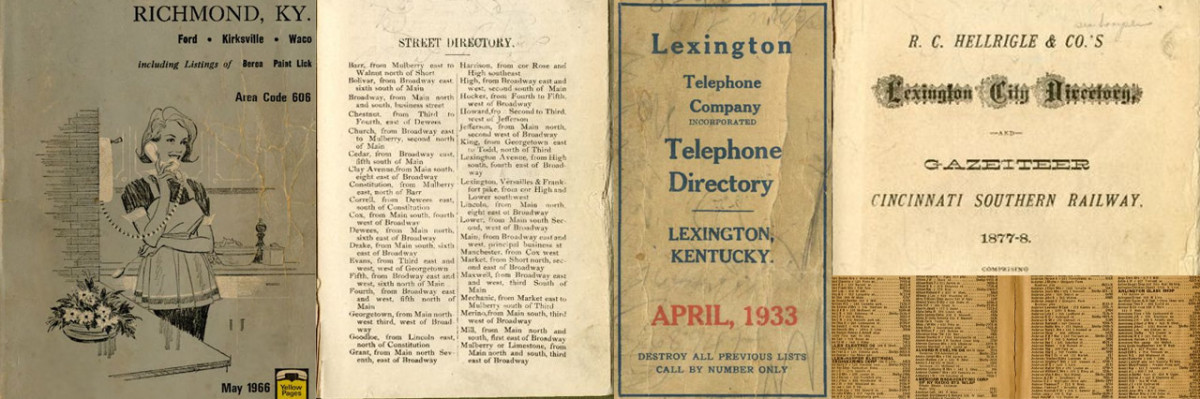
The library has a variety of directories and yearbooks with local information. In the library's current digital collection, there is a selection of residential and street directories, yearbooks, school directories, and organizational directories. These are all fully word-searchable.
The first Kentucky almanacs were printed by John Bradford, on the same printing press that published the Kentucky Gazette. The Kentucky almanacs in the library's…
Fayette County's buildings contain a great deal of history about the region and its inhabitants. The earliest structure in Lexington was built in 1779, the Blockhouse. Lexington currently has over…
The collection consists of an image, homemade brochures, flyers, pamphlets, and programs covering LGBTQ+ events and places from 1983 to 1999 in both Lexington and Louisville. Subjects include…
The Bath County Memorial Library was founded in 1949 by the Owingsville Women’s Club, and opened in January, 1950. It expanded into a bookmobile in 1953, and in 1963 moved into the old Farmer’s…
The Black Community News Collection compiles searchable newspaper articles and ads for local Black community events, schools, social gatherings, church events, obituaries, and wedding…
The Brown-Hocker Collection is a community collection of photos and realia from African American events and people in Lexington and Kentucky history.
The objects in the collection are…
This collection contains materials from Lexington and Fayette County religious groups.
Compiled by Cyrus Parker Jones, a man formerly enslaved by the Parker family, these funeral notices cover 667 funerals of individuals in Lexington, including seven free blacks. The funeral notices…
The Daily Lexington Atlas ran from December 11, 1847 through November 20, 1848 and was Lexington’s first daily paper, and the first to publish information from the telegraph lines. It was…
The library has a variety of directories and yearbooks with local information. In the library's current digital collection, there is a selection of residential and street directories, yearbooks,…
Various objects found in our Duncan-Goff scrapbook collection.
Elmer L. Foote served as official photographer of the Cincinnati Public Library for many years, and produced photographs that appeared in the Cincinnati Commercial Tribune …
Letters from and/or about Father William T. Punch and the Punch family. Donated by a Lexington resident to Lexington Public Library. Father Punch was instrumental in building…
Until 1974, Lexington and Fayette County had two separate governing bodies. Lexington itself was founded in 1775 and chartered in 1782 by an act of the Virginia General Assembly,…
The St. Paul Catholic Church Collection includes materials from the Church's archive. The Roman Catholic church is over 150 years old, and is located on West Short Street, in downtown Lexington.…
Founded in 1982 by Gigi Galore (Greg Butler) and Blanche Pink (Marlon Austin), the Imperial Court of Kentucky, Inc., is a nonprofit charity that supports the LGBTQ+ community of…
The Judge Kenneth Lyons collection consists of an atlas, a journal, and letters. The atlas features copies of letters written on the blank pages of the atlas. The journal contains family and local…
The Junior League of Lexington (JLL) is a local nonprofit organization of women committed to improving community through volunteerism. The first Junior League was established in 1901…
The diary (ca. 1899) of Katherine Pettit, details her settlement work for the Kentucky Confederation of Women's Clubs, made yearly trips to Hazard during this period and was a central figure in…
The Dunn Photograph Collection contains images of Lexington, KY taken in the 1960s and 1980s. Keller J. Dunn (1917-2000) born in Lexington, KY, shot hundreds of pictures of…
The library's collection contains many event pamphlets for Lexington and Kentucky counties, including county anniversary celebrations, suffragette songs, chautauquas, and community events and…
The photographs in the library's collection are donated from a variety of individuals.
The Ashland-McDowell Collection shows an unknown gathering of friends and…
The Kentucky Progress Commission was formed in 1928 in order to draw tourism and business to Kentucky. It was formed by the Kentucky Legislature, and was a 12 person board. The “Kentucky…
The League of Women Voters of Lexington, Kentucky, was established in 1920. It is the local chapter of a national nonpartisan nonprofit organization that encourages informed and…
The Lexington History Museum began in 1998, and opened its doors in the Old Courthouse in 2003. Its purpose is to educate Fayette County about its rich history, and preserve pieces of that history…
The Lexington Public Library opened a Carnegie library in 1905. It incorporated the collections of the former subscription Lexington Library Company (est.1801) and the former…
The Lexington Weekly Press was published every Wednesday in Lexington, Kentucky, and contained local, state, and foreign news. The paper focused on Central Kentucky’s “agriculture,…
The military history collection contains relevant histories and records that focus on Kentuckians involved at home and abroad, and includes a collection of United States Army Training Center…
The Micellaneous Newspaper collection combines scattered issues of various historic newspapers in our archive collection.
Scans of the Black Marriage records from the Courthouse in Greenville, Kentucky.
The collection contains various postcards featuring places in and around Kentucky and includes a selection donated by the Knowles family. The postcards in the library's collection were donated by…
This is a handwritten series of lectures detailing Samuel D. McCullough's memories of his childhood and life in Lexington, Kentucky, accompanied by letters and a photograph of his house. The…
The Schools and Yearbooks collection contains historical and modern yearbooks and other school documents owned by and donated to the Lexington Public Library.
The Daily Argonaut began in 1895 and seems to have ceased publication in 1899. This collection includes scattered issues from 1896, 1897 and 1898. The paper focuses more on sensational news and…
The Independent Gazetteer was founded and printed by James Charless in 1803, with ads appearing in the Kentucky Gazette about its upcoming…
The Kentucky Gazette was the first paper established west of the Allegheny Mountains, founded by John and Fielding Bradford. The frontier paper focused on East Coast and International news,…
The Kentucky Reporter was published from October 1817-April 1832, by William W. Worsley and Thomas Smith. It is the direct continuation of the The Reporter. Politically, it was a…
The Reporter was published from March 1808-September 1817, by William W. Worsley. It was a Republican paper (Jeffersonian Democratic Republican - liberal at the time). The paper was published…
The True American was an anti-slavery newspaper started by Cassius Marcellus Clay in June 1845. He ran the paper in Lexington until August of 1845, when he published an…
This work contains information about French Emigrants to America over the years 1789-1799, and provides a history of the French Revolution. The work was originally in French, and was translated…